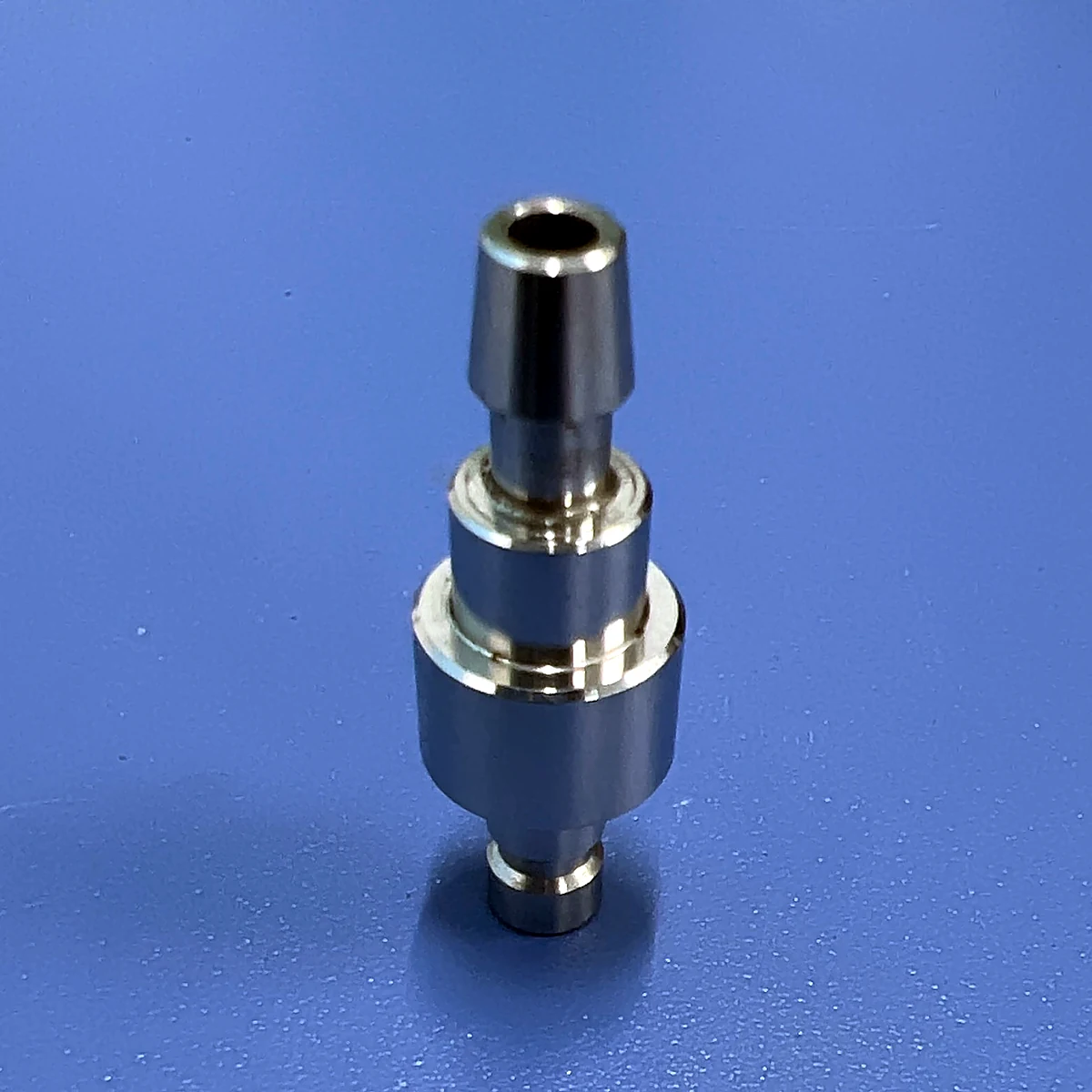
IEC 80369-5:2016 specifies the dimensions and the functional characteristics of small-bore connectors used for limb cuff inflation. It was published in March 2016 as Edition 1, runs to 74 pages under ISO/TC 210, carries ICS 11.040.25 and is classified as an International Standard to be revised. Two corrigenda were issued, Cor 1:2017 and Cor 2:2021, and the consolidated IEC webstore copy includes both. A second edition, IEC/AWI 80369-5, is under development. The Chinese consultation draft used for this reading, GB/T XXXXX.5, was completed in October 2025 and adopts the 2016 text with modifications.
The series and where Part 5 sits
The foreword lists seven parts of the GB/T series: Part 1 general requirements, Part 2 respiratory applications, Part 3 enteral applications, Part 5 limb cuff inflation applications, Part 6 neuraxial applications, Part 7 intravascular or hypodermic applications, and Part 20 common test methods. There is no Part 4 in the list. Part 1 sets out the method for validating the design and dimensions of small-bore connectors so that connectors for different applications cannot be mated and so that each pair forms a safe and reliable connection. Part 20 carries the general test methods supporting the performance requirements. The remaining parts fix the geometry for their own application.
The introduction records why the series was written. Accidents with disastrous consequences were reported in which an inappropriate drug, a liquid nutrition formula or air entered the body through an intravenous line. Those reports produced international agreement that connectors for different applications should be dedicated by design. The introduction also states the dimensional consequence: unless otherwise specified, a connector made to the dimensions of this part is dimensionally incompatible with the connectors of the other applications in the series, and with any other connector identified by the series. If such connectors are fitted to medical devices and accessories, they should prevent air from being infused into a vein.
Clause 1. Scope and its boundaries
Clause 1 covers small-bore connectors intended for limb cuff inflation applications of medical devices and accessories, and names the connection between a sphygmomanometer and its cuff as the application in question. It does not define requirements for the devices or accessories that carry the connectors; those are given in the corresponding device-specific standards. It does not apply to pressurised or depressurised retaining structures that hold an invasive medical device in place, a balloon being the example given.
Three notes extend the scope without changing its limits. Manufacturers are encouraged to introduce connectors conforming to this part even where the applicable device standard does not require them, and the requirements are to be written into device standards when those standards are revised. Requirements for cuff-to-sphygmomanometer connectors intended for neonatal patients will be added by amendment or by a new edition; YY 9706.230 defines the age group for neonatal patients. Requirements for connectors between a tourniquet and its inflation device will be added the same way. GB/T XXXX.1, subclause 5.8, provides the alternative route for a connector that complies with Part 1 but not with this part.
| Within Clause 1 | Outside Clause 1 | |
|---|---|---|
| Connector geometry | S1 small-bore connectors for sphygmomanometer-to-cuff connections | Requirements for the sphygmomanometer, the cuff or the tubing |
| Patient group | Adult and paediatric patients | Neonatal cuff connections, reserved for a future amendment or edition |
| Other inflation devices | — | Tourniquet-to-inflation-device connectors, reserved for a future amendment or edition |
| Retaining structures | — | Pressurised or depressurised structures holding invasive devices in place, such as balloons |
| Alternative designs | — | Connectors complying with GB/T XXXX.1 subclause 5.8 instead of this part |
Modified adoption and editorial changes
The draft is drafted under GB/T 1.1-2020 and is a modified adoption (MOD) of IEC 80369-5:2016. The foreword lists the substitutions made to suit Chinese technical conditions. They matter when a submission file assembled against the published IEC text is reused for a domestic filing, because the citation list changes while the measured data normally do not.
| IEC 80369-5:2016 | GB/T XXXXX.5 draft | Clause |
|---|---|---|
| ISO 80369 series reference | GB/T XXXX | 1 |
| IEC 80601-2-30 | YY 9706.230 | 1 |
| ISO 80369-1:2020 | GB/T XXXX.1-202X | 2, 4.1 |
| ISO 14971:2007 | GB/T 42062-2022 | 3 |
| ISO 5356-1:2015 / ISO 5356-2:2012 | GB/T 45665.1-2025 / GB/T 45665.2-2025 | 4.1 |
| ASTM D638-14 | GB/T 1040.1-2025 | 4.2 |
| ASTM D790-25 | ASTM D790-10 | 4.2 |
The foreword also records the deletion of the older ISO 5356-1:2004 and ISO 5356-2:2006 references, informative substitutions in Annex F for ISO 594-1, ISO 594-2, ISO 80369-2, ISO 80369-3, ISO 80369-5, ISO 80369-6 and ISO 80369-7, the addition of YY/T 0916.7 to Tables F.1 and F.2, the deletion of Annex K, and the replacement of the reference to IEC 80369-5:2016 by "this document" in Annex I.
One editorial change has a direct dimensional consequence. The draft incorporates IEC 80369-5:2016/Cor 2:2021, which changes the minimum of dimension ØW in Table B.2, the inside diameter of the smallest cylinder enclosing the outer surface of the female connector, from 10.060 mm to 9.750 mm. Annex B of this series returns to that value. Published copies that predate the corrigendum carry the higher figure, so a drawing check against an old copy will produce a false failure.
The draft was proposed by the National Medical Products Administration and is administered by SAC/TC 221. Its foreword names seven drafting organisations, including medical device testing institutes and sphygmomanometer and connector manufacturers, and eight drafting engineers. A note states that some content may be covered by patents and that the issuing body does not accept responsibility for identifying them.
IEC 80369-5:2016, clause-by-clause series. Part 1 of 7.